
Lynn Chadwick sharpening Lee Miller’s kitchen knives, Farley Farm, East Sussex, 1957
Photograph by Lee Miller Courtesy of Lee Miller Archives © Lee Miller Archives
The image is disarming: a man leans naked against a tree in the garden at Farley Farm, sharpening kitchen knives. The photographer, Lee Miller — war correspondent, Surrealist, survivor — watches through her lens. The man is Lynn Chadwick, Britain’s newly crowned sculptural hero of 1956, a pilot-turned-artist. He holds Miller’s blades. She holds the camera.
Sunlight falls across his torso, catching the muscles of the arm that draws the knife along the steel. He is relaxed, leaning, but alert — a body at ease and yet under observation. The photographer and her subject look towards one another; their gazes meet across a quiet field of power and exposure.
Who is being seen here? Who is vulnerable? Who controls the image?
This single photograph — a private performance, a domestic ritual, a mutual experiment — opens a space where post-war masculinity and femininity trade positions.
Scene and background
It’s July 1957. Chadwick has just returned from Venice as the youngest ever winner of the International Sculpture Prize. Miller and her husband Roland Penrose are hosting him at their Sussex home, a meeting place for artists still trying to make peace with a war that had shattered Europe. Bird records the moment laconically:
“Miller, who liked to set her guests ordinary domestic tasks and then photograph them at work, shot Chadwick sharpening her kitchen knives in the nude.” ¹
It’s an apparently light anecdote — yet in this tableau the ghosts of war and gender are everywhere: the pilot who once flew over the Atlantic now performing a domestic ritual for the woman who had photographed Dachau.
The body under pressure
In Chadwick’s sculpture, bodies are armoured, fused, geometric. The 1956–57 couples stand taut against invisible wind; their cloaks become carapace. The male body is rendered as architecture — no flesh, no vulnerability.
Miller’s photograph inverts that grammar. Here the man’s flesh is bare, soft, precarious; the woman is the one behind the instrument. The camera becomes another blade. The knife sharpener’s gesture — a functional act of maintenance — becomes an allegory of post-war masculinity disarmed, stripped of its uniform and its sculptural casing.
Miller, whose war photographs showed men dead, defeated, or liberated, now turns that same gaze on the male body alive but unguarded. The pose fuses domestic labour with erotic exposure, war with the kitchen, the survivor’s tools with the artist’s hands.
Gender and agency
For a decade British art had been rebuilding male authority through iron and bronze — Moore’s reclining mothers, Chadwick’s armoured couples, Armitage’s soldiers of form. At Farley Farm, Miller flips the tableau: a female veteran photographs a male hero at work for her.
Her image stages a reversal of the war-time gaze. In Miller’s combat images, women witness male destruction. Here, she witnesses male survival — but on her terms. She supplies the knives, frames the shot, and renders the body into an object of study. The light is sharp and directional, catching on his skin, accentuating the warmth of flesh against the cool metal of the knives. His stance is balanced, almost statuesque — back resting against the tree, his gaze turned towards Miller. There is nothing awkward about it; he seems composed, absorbed in the act, yet aware of being seen. The moment feels collaborative rather than coercive, charged with an unspoken trust between artist and photographer.
Shared trauma, divergent repairs
Both artists carried the residue of war. Miller had seen the death camps; Chadwick had crashed an aircraft and watched comrades die. Each turned from destruction to construction: she to photography of recovery, cooking, and domestic rituals; he to forging figures out of metal.
In this photograph, those practices meet. Sharpening becomes a metaphor for repair — a repetitive, meditative act. Miller’s lens documents the maintenance of tools that might feed, or wound. The naked body signifies the stripping away of armour — the sculptor undone by the gaze of the photographer who has already seen too much.
It is tempting to read the image as mutual therapy: a brief, witty negotiation between two veterans of very different wars.
Reading the image against their work
If Chadwick’s Couple on a Seat or High Wind solidify movement into form, Miller’s photograph liquefies form back into flesh. Her composition dissolves his architecture; the body, usually hidden beneath bronze planes, is suddenly porous, human, absurd.
Conversely, Miller’s own post-war self-portraits retreat from the battlefield to the kitchen — the house as refuge, cooking as ritual control. To invite Chadwick to sharpen her knives is to extend that ritual to the masculine domain: to let him share in her process of turning violence into domestic order.
The photograph sits halfway between documentation and performance art, decades before those terms were theorised.
Provocation and aftermath
Seen today, the image forces a re-thinking of both artists:
For Miller, it’s a portrait of male vulnerability, an answer to the endless archive of women as muse.
For Chadwick, it’s the only instance where his own body becomes material — a temporary inversion of his practice of objectifying others.
The war made both intimately familiar with death and machinery; this photograph makes them collaborators in re-humanisation.
The naked sculptor, the woman with the camera, the edge of the blade — together they stage a post-war rite of un-armouring, a humanism forged not in bronze but in the encounter of two survivors.
Closing reflection
If Chadwick’s sculpture turned trauma into geometry, and Miller’s war photography turned trauma into testimony, then this image turns trauma into play. It collapses gender, labour, and memory into one bizarre gesture: a man, naked, sharpening a woman’s knives.
In that gesture, the heroic and the domestic, the violent and the tender, the male and the female, all meet and momentarily balance — like two of Chadwick’s welded figures leaning into each other, each holding the other up.
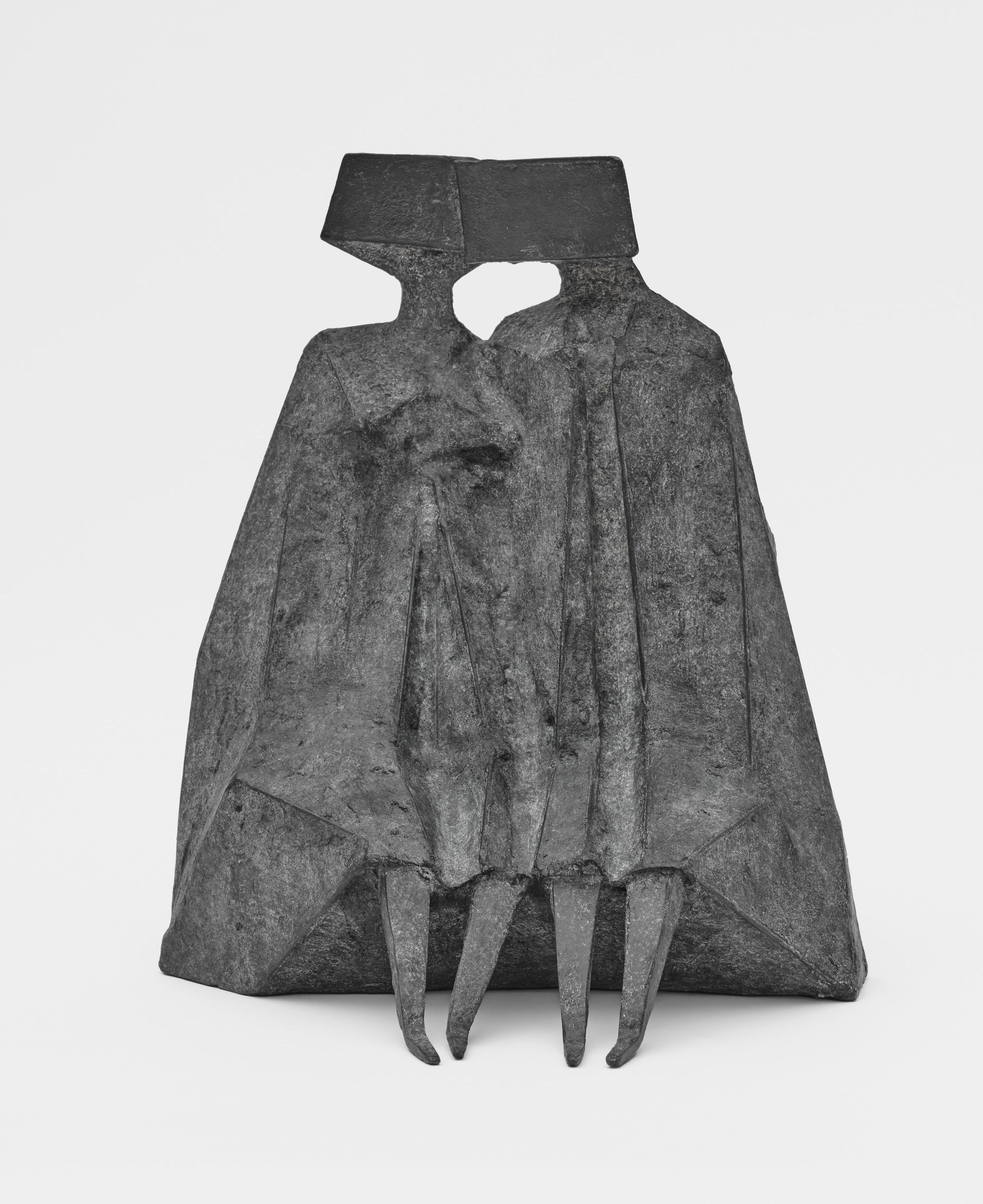
Lynn Chadwick, Sitting Couple, 1979
Photograph Courtesy of Perrotin © Lynn Chadwick
Author’s Note
I have been working with the Lynn Chadwick Estate over the past four years, helping to catalogue the sculptor’s works and spend time with the archive at Lypiatt Studio. My first encounter with this photograph happened during that process, and it stayed with me — a small, disarming moment that shifted how I understood both Miller’s gaze and Chadwick’s own relationship to the human figure.
Two Legacies in the Present
Nearly seventy years after that summer afternoon at Farley Farm, both artists stand newly illuminated. Tate Britain’s exhibition “Lee Miller” revisits her journey from Surrealist muse to war correspondent and experimental photographer, foregrounding her complex negotiations between witnessing and domesticity, between the feminine and the forensic gaze. Across the Atlantic, “Lynn Chadwick: Hypercycle – Chapter II: Archetype (1963–1977)” at Perrotin New York re-examines the sculptor’s mature period — his cloaked couples, striding figures, and spectral geometries that gave form to post-war resilience.
Seen in this light, Miller’s photograph of Chadwick is more than an archival curiosity; it is a hinge between two oeuvres now being re-read. Her camera caught what his sculpture concealed — the living, breathing, vulnerable body beneath the carapace of iron. In turn, his composure before her lens embodied the quiet endurance that her war photography had made visible in others.
As their works are re-presented to new audiences, the photograph returns as a small but potent intersection: a woman of war and a man of form, each reshaping how the human figure might endure pressure, violence, and time — and how, together, art and the body begin again.
Lee Miller, Tate Britain, London, through 15 February 2026
Lynn Chadwick: Hypercycle – Chapter II: Archetype (1963-1977), Perrotin, New York, through 20 December 2025
¹ Michael Bird, Lynn Chadwick (London: Lund Humphries, 2014), p. 95.
Text by Joe Madeira
Lee Miller at Tate Britain
Lynn Chadwick at Perrotin NY
Keywords: Lee Miller Lynn Chadwick photograph